

The Iron Law of Vertical Separation: Keeping the Skies Stacked Safely
Vertical separation is the non-negotiable vertical buffer between aircraft in controlled airspace—the invisible spacing that prevents mid-air collisions when lateral or longitudinal separation cannot be guaranteed.
In most controlled airspace worldwide, the baseline standard remains 1,000 feet (≈300 metres) below FL290 (29,000 ft). This applies across the lower and mid-levels where the majority of traffic climbs, descends, and operates in terminal and en-route environments. The 1,000-foot minimum accounts for altimeter tolerances (typically ±75–200 ft depending on certification), turbulence-induced excursions, autopilot response times, and the brief delay inherent in any human or automated correction. When two aircraft maintain at least this difference in pressure altitude—even if their projected ground tracks intersect—they are considered vertically separated and safe.
The High-Altitude Bottleneck—and the RVSM Revolution
Above FL290, the story changed dramatically in the pre-RVSM era. Pressure altimeters become progressively less precise with increasing altitude because the rate of pressure change per foot diminishes in the thinner upper atmosphere. A small pressure-sensing error translates into a larger altitude error at height. To preserve safety margins, ICAO long mandated 2,000 feet of vertical separation above FL290. While conservative and effective, this created a serious inefficiency: vast swathes of the most fuel-efficient cruising band (roughly 29,000–41,000 ft) were under-utilised, forcing many aircraft into suboptimal levels, burning extra fuel, generating delays, and constraining route flexibility on the world’s busiest oceanic and continental trunk routes.
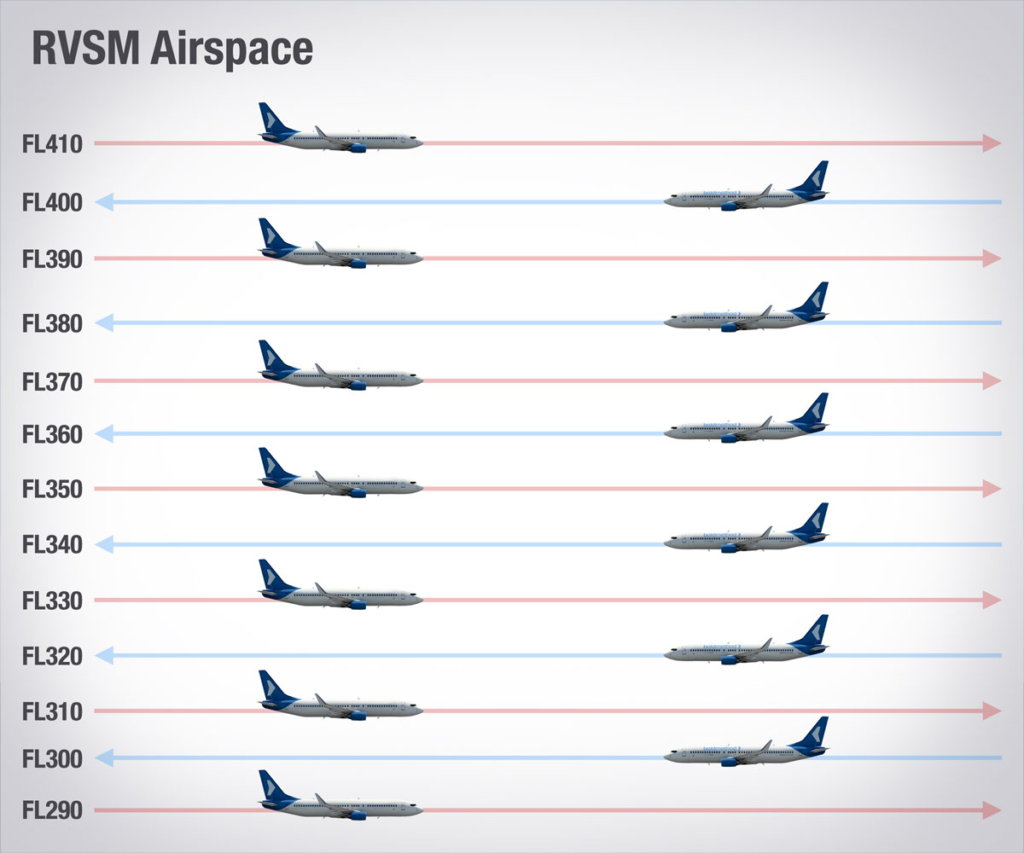
Enter Reduced Vertical Separation Minima (RVSM)—one of the most impactful airspace-efficiency programmes in modern aviation history. Implemented globally between the late 1990s and mid-2000s (with full worldwide coverage by 2005), RVSM slashed the vertical separation requirement back to 1,000 feet between FL290 and FL410 inclusive. This effectively doubled the number of usable flight levels in the prime jet-stream cruising band, transforming airspace capacity almost overnight.
What RVSM Demands: Precision Engineering Meets Regulatory Rigor
RVSM is far more than a paperwork rule change; it rests on stringent technical and operational requirements:
- Aircraft equipage — Dual independent altitude-measurement systems (usually air-data computers feeding highly accurate altimeters), an altitude-keeping autopilot capable of holding assigned level within tight tolerances (±65 ft total vertical error under normal conditions), and an automatic altitude-reporting transponder (Mode C or Mode S/ADS-B).
- Airworthiness and operational approval — The airframe must be RVSM-certified, and the operator (airline or private) must hold specific RVSM authorisation from the state of registry or responsible authority, including ongoing monitoring programmes and height-keeping performance checks.
- Real-world payoff — By halving the separation in the busiest high-altitude stratum, RVSM unlocked dozens of additional flight levels, enabling more aircraft to fly closer to their optimum altitudes. The cumulative fuel savings run into billions of dollars globally, while reducing en-route delays and controller workload on saturated corridors.
The Human Backbone: Air Traffic Controllers as Guardians of the Stack
No matter how sophisticated the onboard systems or how precise the surveillance, vertical separation in real time is orchestrated by ATC. Working in Area Control Centres, controllers rely on a layered safety net:
- Primary/secondary radar, ADS-B, and multilateration for continuous 3D position and altitude tracking.
- Strict assignment of Flight Levels (pressure-altitude referenced to the standard 1013.25 hPa datum).
- The semi-circular (or East–West) rule: eastbound traffic (magnetic track 000°–179°) typically receives odd thousands (FL310, 330, 350…), while westbound (180°–359°) receives even thousands (FL300, 320, 340…). This directional alternation adds an extra procedural safety layer on top of the 1,000-foot minimum.
Controllers continuously monitor adherence—watching Mode C readouts, cross-checking reported levels, and issuing immediate level-change instructions or vectors if any deviation appears. A single 300-foot bust can trigger an immediate safety alert; sustained or significant excursions prompt urgent intervention.
In essence, vertical separation remains aviation’s most fundamental collision-avoidance principle—simple in concept, extraordinarily robust in execution, and continuously refined through technology and discipline. From the classic 1,000-foot rule below FL290 to the RVSM-enabled efficiency above it, the system ensures millions of flights pass safely each year in an environment where there is literally no margin for complacency.